
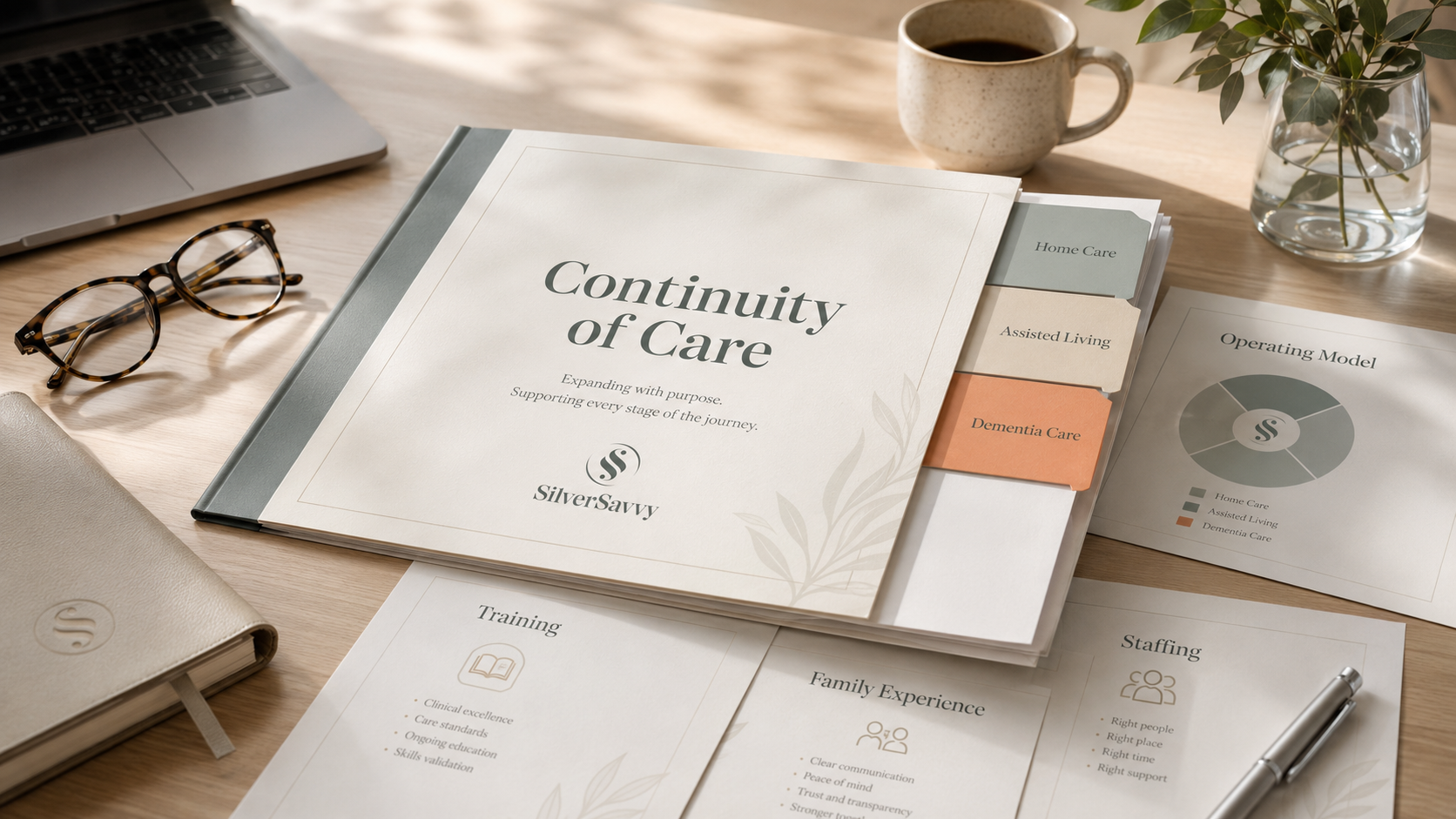
Home care can be a smart growth strategy for assisted living providers. But it requires its own operating model, caregiver profile, technology infrastructure, training discipline, and margin strategy.
It is easy to see why assisted living providers are looking at home care.
Families need help earlier. Older adults want to stay home longer. New senior housing development remains constrained. Technology makes field-based care easier to manage than it once was. And operators are looking for growth that does not depend only on adding another building.
The opportunity is real.
AARP’s 2024 Home and Community Preferences Survey found that 75 percent of adults age 50 and older want to stay in their current homes as they age, and 73 percent want to remain in their communities. That tells us something important: many families will look for help long before they are ready to consider assisted living.
At the same time, senior housing demand is strengthening while new supply remains tight. NIC reported that senior housing occupancy reached 89.9 percent in the second quarter of 2026, with assisted living inventory growth at only 0.3 percent year over year.
For leadership in Assisted Living, this raises a serious strategic question:
Can we serve families earlier, extend our brand beyond the building, and create a more connected path of care while protecting margin, execution, and trust?
I believe the answer can be yes.
But home care is not assisted living without the building.
It is a related business, but it is a different business. The revenue model is different. The management rhythm is different. The caregiver profile is different. The technology needs are different. The training challenge is different. Even the reward and recognition model has to reach people in a different way.
I have seen this from both sides. I owned and operated home care companies, and I have worked closely inside assisted living operations. Earlier in my career, I also helped large organizations think through complex operational transitions. That combination shaped how I look at this opportunity.
Families do not think in service lines. They think:
Mom is changing. We need help. I do not know how much help, where it should happen, or what comes next.
That is why this adjacency makes sense.
The question is whether it is built with the discipline it deserves.
Families already experience care as a journey
When I owned my home care company, I learned quickly that families were buying more than hours of care.
They were trying to understand what was happening.
Some needed help staying home safely. Some were trying to delay assisted living. Some were recovering from a hospitalization or rehab stay. Some were beginning to realize that home was becoming harder to sustain. Others needed a trusted person in the home who could notice changes before the family reached a crisis.
The more we helped families understand that whole path, the more valuable we became.
We supported people at home. We also helped families recognize when more hours were needed, when the care plan had to change, and when assisted living should become part of the conversation.
That is why home care can become a powerful relationship bridge for assisted living providers. It allows the organization to meet the family earlier, provide meaningful help sooner, and build trust before a move is needed.
The strongest opportunity is relationship.
A senior living organization that supports families well at home may become the organization they trust when home is no longer enough.
The operating model changes when care leaves the building
Inside assisted living, the building is part of the operating model.
There are leaders on site. Nurses nearby. Dining, programming, maintenance, housekeeping, reception, medication systems, other caregivers, and established routines. If something changes, someone may see it in the hallway, at lunch, during care, or at the front desk.
Home care is different.
The work happens in private homes, often one caregiver, one client, one family, and one set of expectations at a time.
That changes the management model.
You are no longer managing one building. You are managing care across many small environments that you do not fully control. Each home has its own routines, risks, family dynamics, communication patterns, boundaries, and emotional tone.
In assisted living, a leader can walk the halls.
In home care, leaders need systems that help them know what is happening in the field before small issues become larger ones.
That requires strong intake, caregiver matching, scheduling discipline, family communication, visit notes, field supervision, escalation protocols, quality checks, and change-in-condition reporting.
This is where technology matters.
Home care can scale more effectively today because technology can support scheduling, caregiver matching, documentation, family updates, billing, payroll, training, and quality assurance. A 2026 home care industry survey reported that AI was identified by 65 percent of respondents as the leading technology trend in home care, with expected impact in client and caregiver shift matching and automated scheduling.
But technology is not the strategy by itself.
Technology can help scale oversight.
It cannot replace judgment, caregiver fit, supervision, or culture.
The best operators understand that technology should strengthen the human work, not pretend the human work is simple.
The caregiver profile has to match the setting
One of the first operating questions is staffing.
It may be tempting to think, “We already have caregivers. Why not send them into homes?”
Some caregivers can thrive there.
Some will not.
That does not make one caregiver better than another. It means the setting matters.
In assisted living, caregivers work inside a team-based environment. There are routines, colleagues, supervisors, nurses, dining staff, activity staff, and other supports around them.
In home care, the caregiver is often alone in someone’s private home. That caregiver represents the organization without a manager down the hall. They have to read the room, manage boundaries, notice changes, communicate clearly, and remain steady when a client refuses care or a family member is anxious.
This is one of the clearest differences:
In assisted living, the caregiver works inside the environment. In home care, the caregiver often becomes the environment.
That requires a different level of independence, judgment, flexibility, reliability, and comfort with ambiguity.
When I owned my home care company, we developed role-specific success profiles and assessed candidates against the values, skills, behaviors, and working style each position required. We did this for field caregivers and home office roles because the goal was not simply to hire good people. The goal was to build an operating ecosystem that worked together.
Home care cannot become field staff versus office staff.
Scheduling, supervision, caregiver communication, family updates, care plan changes, and service recovery all depend on trust between the people in the home and the people supporting them from the office.
That ecosystem has to be designed.
Training becomes a scale lever
Home care can only scale if training moves from information to field performance.
That is especially true with dementia care, personal care, boundaries, documentation, fall risk, infection control, and family communication. A caregiver may understand a concept in training, but the real test comes later, alone in a private home, when a client refuses a shower, becomes suspicious, repeats the same question, or grows anxious near the end of the day.
That is where training has to show up.
The strongest operators do not treat training as a one-time onboarding requirement. They reinforce it through field coaching, supervisor follow-up, scenario-based learning, visit-note review, family feedback, and practical refreshers tied to real cases.
The question is not only:
Did we train the caregiver?
The better question is:
Did the training become part of how care is delivered in the home?
That is the standard.
Margin is won or lost in the schedule
Home care can be profitable, but it is not profitable simply because demand exists.
The economics are different from assisted living.
In assisted living, leaders think about occupancy, rent, care levels, staffing patterns, dining, fixed costs, and building performance.
In home care, revenue is tied to billable hours. Margin can be affected quickly by short shifts, travel gaps, call-outs, cancellations, overtime, poor matching, weak retention, inconsistent clients, supervision costs, and scheduling inefficiency.
In home care, margin is won or lost in the schedule.
That is why home care needs its own operating discipline. It requires clear thinking around minimum hours, pricing, caregiver pay, travel time, overtime, cancellation policies, intake standards, staffing capacity, and case selection.
Not every case is a good case.
Some clients need more structure than home care can safely provide. Some families want more than they are willing to pay for. Some schedules are difficult to staff. Some homes are unsafe. Some needs require home health, hospice, or a higher level of care.
A strong home care division knows what it can do well.
It also knows what it should not take on.
That discipline matters more as economic pressure rises. The 2026 home care survey reported that profitability concerns increased from 13 percent to 34 percent, and caregiver shortages remained the top pain point, cited by 53 percent of agencies.
This is why home care has to be managed as its own business.
Recognition has to reach the field
In assisted living, recognition often happens in person. A leader can thank someone in the hallway, recognize a team at stand-up, celebrate a great moment in a staff meeting, or notice when someone goes above and beyond.
Home care caregivers are more isolated.
They may go from home to home without feeling connected to the organization unless the company is intentional about communication, recognition, training, and belonging.
That changes the reward and recognition model.
Recognition has to reach caregivers where they are: phone calls, texts, field visits, client compliments, spot bonuses, peer connection, flexible scheduling, practical support, and consistent appreciation from supervisors.
This is not soft.
It is retention strategy.
If caregivers are alone in the field, connection cannot be an afterthought.
The leadership takeaway
For assisted living leaders, home care is a build, buy, partner, or pause decision that deserves the same discipline as any growth strategy.
The opportunity is attractive: earlier family relationships, revenue diversification, brand extension, smoother transitions, and a broader role in the aging journey.
But readiness matters.
Before launching, leaders should be clear about whether they have the leadership capacity, field supervision model, caregiver profile, technology infrastructure, training discipline, referral strategy, and margin visibility to support a distributed care business.
A home care division needs clear ownership. It needs its own operating rhythm. It needs a margin dashboard that tracks the details that actually drive performance: billable hours, minimum shifts, cancellations, overtime, travel time, caregiver retention, case mix, and supervisory cost.
It also needs a clear family promise.
Is the goal to help families stay home longer? Create a smoother bridge to assisted living? Extend the organization’s relationship with families beyond the building? All three may be valid, but the strategy needs to be clear.
Home care can make an assisted living organization more valuable to families and more connected to the full aging journey.
But only when it is built as a true operating business, not as an idea attached to an existing building.
Home care may be the right next step
If your assisted living organization is exploring home care as an adjacent business, SilverSavvy can help you think through the strategy before you build.
A Home Care Readiness Conversation can help evaluate your family journey, referral opportunity, operating model, caregiver profile, management and supervision structure, technology needs, training approach, reward and recognition model, margin assumptions, and implementation risks.
Home care can be a smart extension of assisted living, but only when it is built with intention.
To explore whether a home care division makes sense for your organization, schedule a SilverSavvy Home Care Readiness Conversation.
Warmly,
Laura Lynn Morrissey
Founder, SilverSavvy
[email protected]
Source note: This article was informed by SilverSavvy’s experience in home care and assisted living operations, along with industry data and reporting from AARP, NIC, Senior Housing News, and HomeCare Magazine.